How-to
How to make UGC ads without hiring creators (2026 workflow)
A step-by-step workflow for producing UGC-style video ads with AI creators instead of hiring, briefing and paying human UGC creators — including scripts, costs, timelines, disclosure rules and testing cadence.
VydioFlow Team · Published August 21, 2026 · Updated August 21, 2026 · 13 min read
Key takeaways
- You do not need a creator roster to ship UGC ads — you need an angle, a hook, a script and a repeatable render loop.
- A human UGC creator typically costs $150–$400 and 7–14 days per video; an AI-generated equivalent costs a few dollars and renders in minutes.
- Pair a generated presenter with your real product photos or screen recordings; fully synthetic ads with no real product convert worse.
- Write one script per angle and five to ten hooks per script, then render the hooks first before committing budget to full ads.
- Label AI-generated ads with the platform's own AI disclosure tools and never fabricate testimonials, results or named customers.
UGC-style ads work because they look like a person talking, not like an ad. That is also why they have been so painful to produce: to get twenty variations you historically had to source twenty creators, brief them, ship product, wait two weeks, and then accept whatever footage came back. Most small teams gave up after one round.
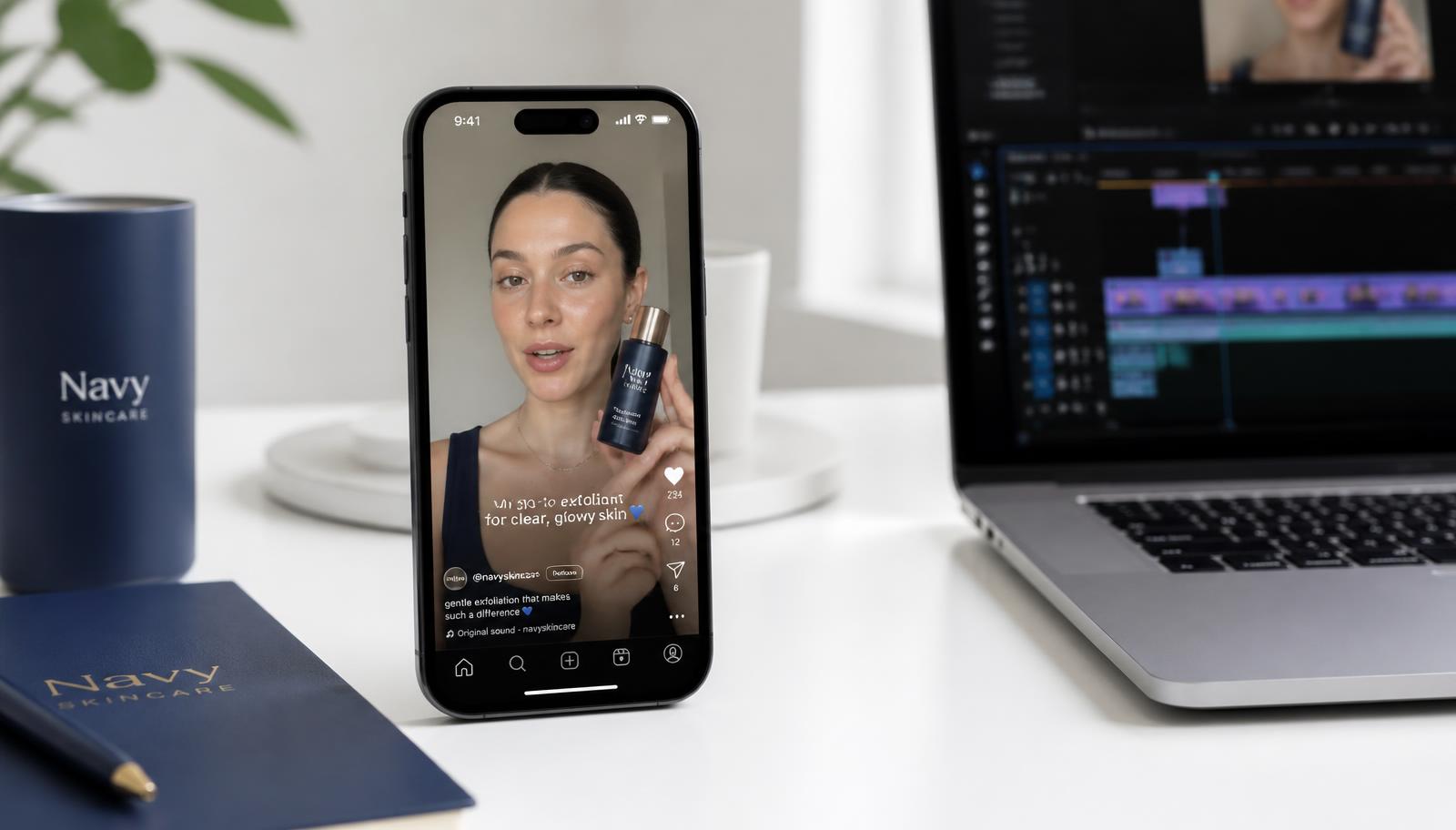
In 2026 you can produce the same format without hiring anyone. AI creators — synthetic on-camera presenters — deliver your script in a handheld, selfie-style shot, and you intercut that with your own product photos or app recordings. The output looks like UGC, tests like UGC, and costs a fraction of a creator brief.
This guide is the practical version: exactly what to write, what to generate, what to supply yourself, what it costs, and how to test the results so you know which ad to scale.
Why teams skip human UGC creators now
The case against hiring is not that creators are bad — good ones are excellent. It is that the unit economics only work once you already know your winning angle. Discovery is the expensive part, and discovery needs volume.
- Cost per video: a mid-tier UGC creator charges roughly $150–$400 per video in the US, plus product cost and shipping.
- Turnaround: seven to fourteen days from brief to delivery is normal, longer with revision rounds.
- Revisions: a wrong hook usually means a full reshoot, because you cannot re-record one line in isolation.
- Variation ceiling: testing ten hooks means ten briefs. Most teams test two and call it a test.
- Rights: usage windows, whitelisting fees and renewals add ongoing cost after delivery.
What you need before you generate anything
The tool is the easy part. Ads fail on inputs, not on rendering. Collect these five things first — it takes about thirty minutes and it is the difference between usable ads and generic filler.
- One specific audience. Not "women 25–45" — "people who have tried three retinols and got irritation."
- One problem sentence, written in the customer's words, ideally lifted from a review or support ticket.
- Three to five real product assets: photos on a plain background, a lifestyle shot, packaging, or a screen recording for software.
- Your offer and proof: price, guarantee, shipping, or a verifiable stat. Only claims you can substantiate.
- A single call to action. One. Multiple CTAs measurably reduce click-through.
Step 1 — Pick the angle before the script
An angle is the reason this specific person should care. Most brands run one angle ("our product is good") and wonder why creative fatigues in a week. Write three angles per product and treat them as separate ad concepts.
For a skincare serum, three angles might be: irritation-free alternative to retinol, a two-week visible-results story, and a cost comparison against a facial. Same product, three completely different ads, three different audiences.
- Problem/solution — name the pain in the first line, then resolve it.
- Comparison — against the obvious alternative, including doing nothing.
- Objection handling — take the top reason people do not buy and answer it head on.
- Use-case demo — one specific situation where the product wins.
- Before/after — only if you can show something real and honest.
Step 2 — Write a script that sounds spoken, not written
UGC scripts are short. For a 20-second ad you have roughly 50 to 60 spoken words. Write them the way a person actually talks: contractions, one idea per sentence, no marketing adjectives stacked three deep.
Structure it in four beats and keep each beat to a single job:
- Hook (0–3s): the scroll-stopping line. State the problem or the surprising claim.
- Context (3–8s): why the viewer should believe you are talking about them.
- Payoff (8–16s): the product, shown — this is where your real product asset goes.
- CTA (16–20s): one action, phrased plainly. "Link's right here, first order ships free."
Step 3 — Generate five to ten hooks before the full ad
This is the single biggest workflow change versus hiring. Because generation is cheap, you render the hook — the first three seconds — many times before committing to a full ad. Cheap hook testing is the entire advantage.
Write five to ten openers for the same script body. Change only the first line. Render them at your platform's lowest quality tier, put them in front of a small audience, and read three-second hold rate. Then build the full ad around the two openers that held.
- "I stopped buying [category] after I found this."
- "If your [problem] keeps coming back, it's probably this."
- "Nobody told me [surprising fact] until I was already out $200."
- "Three things I wish I knew before buying [category]."
- "This is what [price] actually gets you."
Step 4 — Choose one AI creator and keep them
Pick a presenter whose apparent age, setting and energy match the audience you wrote for. A twenty-two-year-old in a dorm room does not sell enterprise software; a person in an office does not sell dorm-room snacks.
Then keep that creator across the whole campaign. Familiarity compounds — repeat exposure to the same face is one of the few reliable ways to lift recall in short-form. Rotate the creator only when you rotate the audience.
Step 5 — Add your real assets
The most common mistake in AI UGC is a fully synthetic ad where the viewer never sees the actual product. Upload your own photos, packaging shots, or a screen recording and make sure they appear during the payoff beat.
On VydioFlow you can paste a product URL and the pipeline pulls the imagery and offer details automatically, or upload up to three images — logos, website screenshots, product photos — as visual references for the generated scenes.
Step 6 — Caption, crop and export for each placement
Most first exposures happen with sound off, so burn in captions rather than relying on platform auto-captions. Keep on-screen text under about seven words per card and make sure the core promise reads silently.
Export 9:16 for TikTok, Reels and Shorts, 1:1 for feed, and 4:5 where the placement allows it — 4:5 buys extra vertical real estate in Meta feeds. Keep captions and product inside the safe area so platform UI does not cover them.
What it costs: hiring vs generating
Here is the honest comparison for producing ten ad variations, which is the minimum for a real creative test.
- Hiring: ten creators at $150–$400 each is $1,500–$4,000, plus product and shipping, over two to four weeks including revisions.
- Generating: ten variations on VydioFlow at Standard quality run 30 credits each and render in minutes, so a single Starter month covers a full test cycle.
- Iteration cost after launch: a reshoot versus a re-render. That gap is why generated creative wins on testing velocity even when a human creator makes a better single video.
- Where hiring still wins: authentic long-form testimonials from real verified customers, and any claim that requires a real person to stand behind it.
Staying compliant and honest
AI-generated presenters are permitted across the major ad platforms, but they come with rules and those rules tightened through 2025 and 2026. Two lines you should not cross: do not present a generated person as a real named customer, and do not invent testimonials, ratings, medical outcomes or earnings claims.
Use the platform's own AI-content disclosure controls — Meta, TikTok and YouTube all provide them — and keep substantiation on file for any factual claim in the script. FTC endorsement guidance applies to generated endorsements exactly as it does to human ones.
A repeatable weekly loop
Once the first batch is live, the workflow becomes a rhythm rather than a project. Teams that ship weekly beat teams that ship perfectly.
- Monday: review last week's hold rate and cost per acquisition, kill the bottom half.
- Tuesday: write one new angle and five hooks against it.
- Wednesday: render ten Standard-quality variations, review, pick two.
- Thursday: re-render the two winners at a higher quality tier with your product assets.
- Friday: launch, and let the data decide next Monday's angle.
The short version
Making UGC ads without hiring creators is not a workaround — it is a faster version of the same job. You still need a specific audience, a real problem, an honest offer and a spoken-sounding script. What changes is that testing twenty hooks costs an afternoon instead of a month, so you find the winning angle before your budget runs out.
Start with one angle, ten hooks, one creator and your own product photos. Ship it this week, then let hold rate tell you what to write next.
Frequently asked questions
Can I really make UGC ads without hiring a creator?
Yes. AI creators deliver your script in the same handheld, selfie-style format that human UGC uses, and you supply the real product footage. The format, pacing and captions are identical — only the on-camera presenter is generated.
Do AI UGC ads perform as well as ads from real creators?
On a single-video basis a great human creator often still wins. On a campaign basis generated ads usually win, because you can test ten to twenty hooks for the price and time of one creator brief and find the angle that actually converts.
How much does it cost to make a UGC ad with AI?
On VydioFlow a Standard-quality generation costs 30 credits, Pro costs 70 and Cinema costs 175, and plans start at $39 per month. Compared with $150–$400 per video for a human UGC creator, a full ten-variation test fits inside an entry plan.
Is it allowed to run AI-generated UGC ads on TikTok and Meta?
Yes, with disclosure. Meta, TikTok and YouTube all provide AI-content labels and expect you to use them for realistic synthetic people. What is not allowed is presenting a generated presenter as a real named customer or fabricating testimonials, results or medical and financial claims.
What do I need to supply for a good AI UGC ad?
A specific audience, a problem written in the customer's own words, three to five real product assets or a screen recording, your offer and proof, and one call to action. The generator handles the presenter, scenes and captions.
How long does it take to make one?
Minutes per render. A realistic first session — writing the angle, drafting hooks, rendering ten variations and picking two — takes about an hour, versus one to two weeks waiting on a creator delivery.
How many variations should I test at once?
Ten is the working minimum across two or three angles. Judge on three-second hold rate first, then cost per acquisition, and promote only the top one or two to a higher quality tier for scale spend.